Goalkeeping Mindset
People describe goalkeepers as if calm were a personality type you either got or did not. "He is just built for it." I have played with keepers who looked built for it and fell apart in a cup tie, and keepers who were visibly nervous and never once let it touch their hands.
The difference was not temperament. It was preparation. Calm is a skill, and skills are trained.
Understand what you have signed up for. You are the only player on the field whose mistakes are final. A striker misses five chances and scores in the 90th and he is a hero. You misjudge one cross and it is on the highlight reel forever.
You also spend most of a match doing nothing, which means your concentration has to survive long stretches of boredom and then produce its best work instantly, with no warning. There is no other position in team sport quite like it.
That is not a reason to be fragile about it. It is a reason to train for it specifically, the same way you train diving.
The single most valuable mental skill in goalkeeping is what you do in the ten seconds after conceding.
Watch a young keeper concede. He stands looking at the net. He replays it. He looks at the defender who should have tracked the runner. He is still in the last thirty seconds while the game has already restarted, and now he is out of position for the next attack because his head never came back.
Elite keepers have a physical routine for this, and it is deliberately physical, because you cannot talk yourself out of a thought but you can move yourself out of one. Get the ball out of the net yourself. Touch a post. One long breath out -- longer than the breath in. Say one instruction out loud to your back line. Then you are set for the restart.
It looks like nothing from the stands. It is the whole game.
Here is what most people get wrong: they try to be mentally tough on match day. Match day is far too late. You cannot install a reset routine while your heart rate is at 180 and your parents are watching.
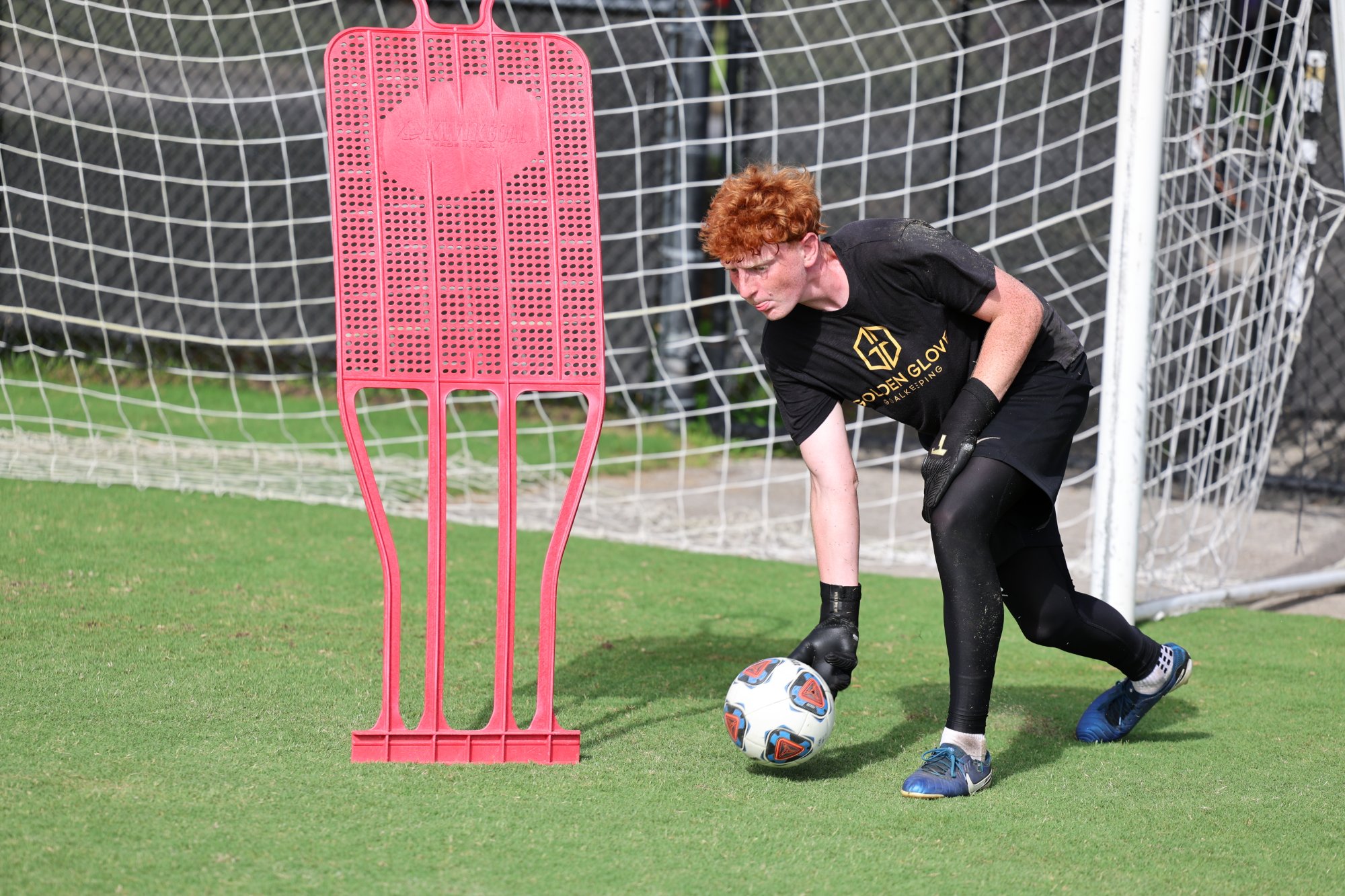
So we build it in training, where a mistake costs nothing. In our sessions at Golden Glove, when a keeper gets beaten in a drill, I want the same routine every time -- ball retrieved, breath out, one word, reset. Fifty repetitions in training and it will be there on Saturday without you having to summon it.
That is the whole trick. You are not building courage. You are building a habit that runs when courage is unavailable.
A pre-match routine that never changes. Same order, same warm-up, same first touches. The point is not superstition. The point is that when everything else about the day is unfamiliar -- new field, big crowd, college coach on the sideline -- your body gets a stack of familiar signals telling it this is normal.
Concentration cues for the quiet spells. When play is at the other end, most keepers switch off and then get caught cold by a counter. Give yourself a job instead: check your position against the ball line, count your defenders, scan for the runner nobody has picked up, talk. Concentration is easier to hold when it has a task attached.
Rehearsal. Before a match, spend five minutes seeing yourself make specific saves -- a low dive to your weak side, a cross claimed in traffic, a penalty. Do not imagine highlights. Imagine the ordinary version, done correctly. You are giving the movement a rehearsal and giving the moment a sense of having been here before.
Young keepers wait to feel confident, as if it arrives from outside. It does not. Confidence is a memory. It is the accumulated record of preparation you have actually done, and your body knows exactly how honest that record is.
Which means the shortest path to a calmer goalkeeper is not a motivational video. It is another session, done properly, with the weak side attacked instead of avoided.
One last thing worth saying plainly, because this position can be lonely. There is a difference between the ordinary nerves of a big game and genuinely struggling -- dreading matches, not sleeping, carrying it into the rest of your life. If it is the second one, that is not a toughness problem to be solved with a harder session. Talk to your parents, and talk to someone qualified. Every good keeper I know has needed help at some point. Asking for it is not a crack in the armor.
Private sessions and evaluations in Central Florida, led by Coach Gorrick.